
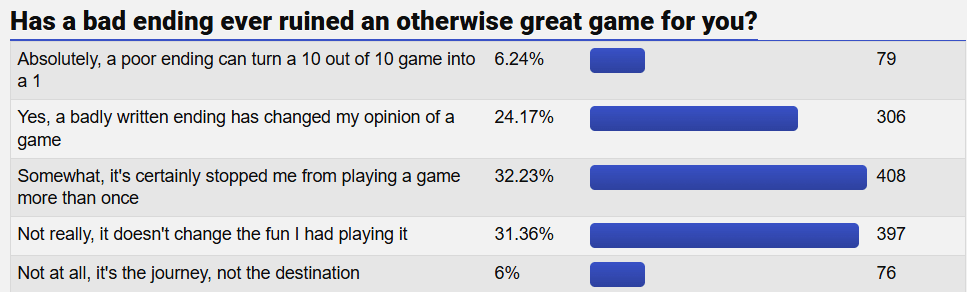
GameFAQs’ Poll of the Day presents us with another tough question: Has a bad ending ever ruined an otherwise great game for you?
If you’ve played games for any serious amount of time, you know how the mantra goes: gameplay is king.
So if gameplay is king, that means it trumps other aspects of the game.
Including the ending.
The ending should never be more important than gameplay!
And I agree that the ending doesn’t change the fact that I had fun with the game.
However, a bad ending does ruin one thing…
…
…the ending.
I know that sounds incredibly self-explanatory, but to understand why I said it, we need to understand what an ending is and what are the implications of a bad ending:
The ending is often one of the last things you see before you shelf the game.
And that’s often more important than we let on. It sets the tone for laying the game to rest. In single-player games, it is often the thing that sticks with us longer than anything that happened before it, because it is the last thing we experienced.
And “the last thing we experienced” is important. Even if you think about a game that has a good ending, if you stop playing that game in the middle because you experienced something way too frustrating, then that is your last experience with that game. And that is the feeling that sticks with you, even if you logically try to remind yourself that the game was okay before that.
And it’s not just video games. The importance of ending your work on a positive note is something that was already understood back in the 17th-century theatre: no matter how sad or tragic a play had been, something called a jig was often performed afterwards to make sure the audience always left in high spirits.
This was important.
It meant a higher chance that the customers would return to the theatre.
And it meant that anybody who saw those livid and happy customers exiting the theatre got a positive impression of the place, increasing their likelyhood of becoming future customers.
Back to video games. I recently played through Metroid Prime 4: Beyond, and I mostly have three things to say about it:
- The gameplay was good (But not perfect. There was something weird about the control scheme that made me press the wrong buttons ever so often, and the “open worldedness” of Sol Valley was not well done.)
- The story was mediocre (The alien race was fine, but the Federation Force members were utterly unnecessary, and there was some missed potential with how the story could have gone.)
- The ending was ass (I honestly don’t even want to think about it, much less talk about it.)
And those three altogether left something of a bad taste in my mouth. The fact that the story and ending (which are things that shouldn’t matter, since gameplay is king) left me in a state where, whenever I try to think whether I could suggest the game to a friend, I end up manually repeating to myself “Well, the game was fine. The gameplay was good. Story and ending don’t matter. The game was fine. The gameplay was good…”
Except, I really shouldn’t have to keep repeating something like that to myself.
I should be able to go on with my life with just the knowledge that it was a good game.
Leaving a few characters out of the story and having a satisfying ending would have guaranteed that I don’t have to second-guess myself when talking about the game.
Gameplay is king. But everything else still matters. Including the ending.
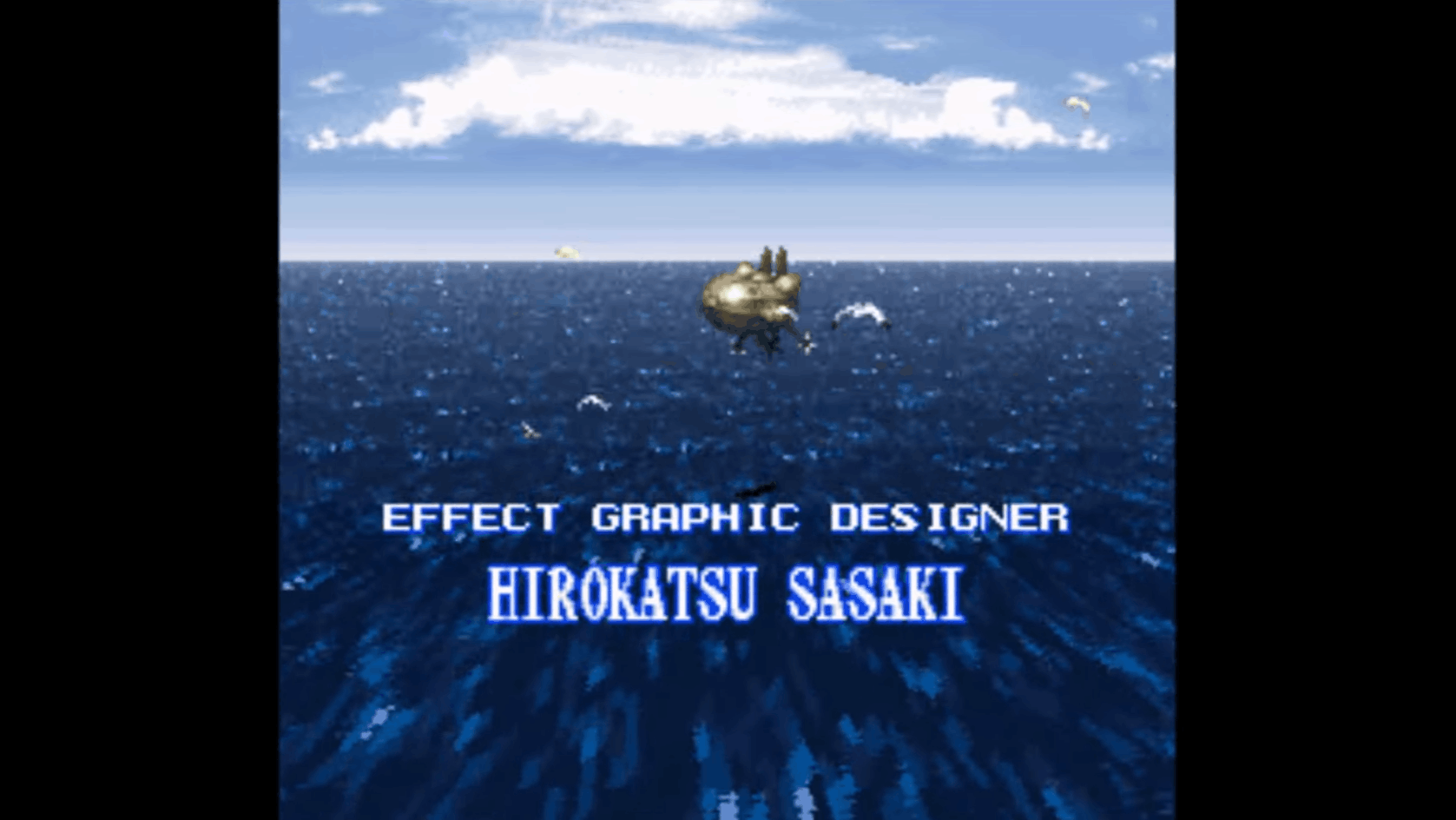
Putting Metroid Prime 4 aside, there is one game I can recommend without second-guessing myself. Final Fantasy 6 is not only a great game with a great story, but it also has one of the grandest endings I’ve ever seen in a video game.


Story and ending does mater if it’s a game that relies on world building like Final Fantasy. Metroid 4 is no exception. You can have the best tools and mechanics in a game. Most top notch controls and graphics. But if the world that is built doesn’t engage with you positively then it fail. Endings can have such an impact that it can trivialize much of the story and work placed in a game. Tragic Endings done wrong can leave a player feeling of failure which is bitter pill. Final Fantasy in your example has Tragedy but as an obstacle to overcome and not as a final destination. Tragedy IMO is good for Shakespeare Kings where you watch as a outsider but Terrible if used against the player for now Fate gave the player the bitter pill and waned their fortunes.
Yeah. As much as it’s true that the gameplay is the most important aspect of any game, if there is a story and an ending, then those will affect the player in some way. A great story with a great ending can sort of save a bad game, but at that point, what was the point of making that story into a game in the first place?
If you have a great story, you don’t need to make it into a video game (or you can opt for more story-focused video game formats like visual novels).
And likewise, if you can’t come up with a good story for your game, the best choice is to not try to force one in there. Give the player the bare minimum (a call to action and a satisfying ending) and let them figure out the rest by OBSERVING and INTERACTING with the game and it’s world!
Games are in a unique position where the player can build a personal story through their own actions in the game. For many players that might not be enough (I recently heard someone critizise the original Wizardry games, saying they’re not worth experiencing because there’s no story), but it’s still always better than a bad, hamfisted story that ruins the game.
There are games like “This is the Police” which has very engaging gameplay and a gripping story with twists and turns, and a tragic ending! But the problem is that the gameplay and story both feel very separate from each other: the character you play as doesn’t feel at all connected to the main character you see in the cutscenes, and no matter how well you play, the ending will always let you down. That game would have definitely benefitted from separating the two into their own products.
Likewise, I think Metroid 4 would have been much better if the story had been ripped out and its ending simplified. The gameplay and atmosphere are there, which means the player’s imagination can carry the rest.
Back when I did theatre, my teachers, collegues and directors would always tell me “Don’t underestimate the audience!” It’s weird that the same is never being taught to game developers.